back
China, 1992. China, 1992. When BIANCALANI’s AIRO®1000 met the Chinese textile industry
In 1992, Chinese technical sources documented conferences, fabric trials and the first industrial applications of AIRO®1000. A story told by others.
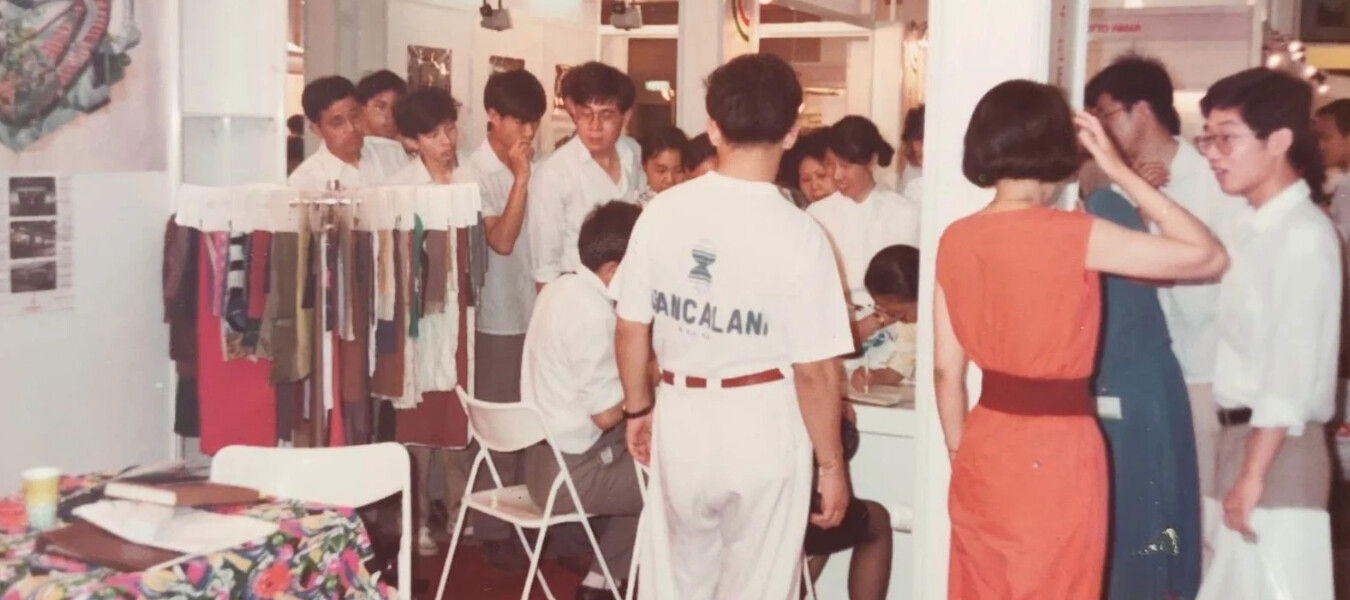 Historical photograph | Technical exchanges at the BIANCALANI stand.
There are documents that, read again after more than thirty years, tell not only the story of a machine, but of a precise moment in its history.
In 1992, the Chinese technical journal SILK - a reference publication for the Chinese textile sector - dedicated a three-page feature to Biancalani’s AIRO®1000, authored by Deng Meiwu, Senior Technical Advisor at the Shandong Textile Machinery Company. The text described the operating principle, the mechanical structure, the possible applications and, above all, the trials carried out directly at Chinese textile companies.
Biancalani’s commercial relationship with China had begun ten years earlier. In 1982, the company sold its first machines for wool processing in Changzhou. The 1992 accounts therefore document a later stage in that relationship, marked by the introduction of AIRO®1000 and its applications in Chinese textile production.
AIRO®1000 had been launched in 1987. Five years later, it had already reached China. And the numbers confirmed it: according to the journal, over 400 units had already been sold worldwide since launch. In 1992 alone, several machines had entered production in the Shandong province. Meanwhile, fabrics treated with AIRO®1000 had already established a trend in Europe that the industry had begun to call “AIRO Finishing” - recognisable for its soft hand, good drapeability and pre-shrinkage effect - commanding significant added value on international markets.
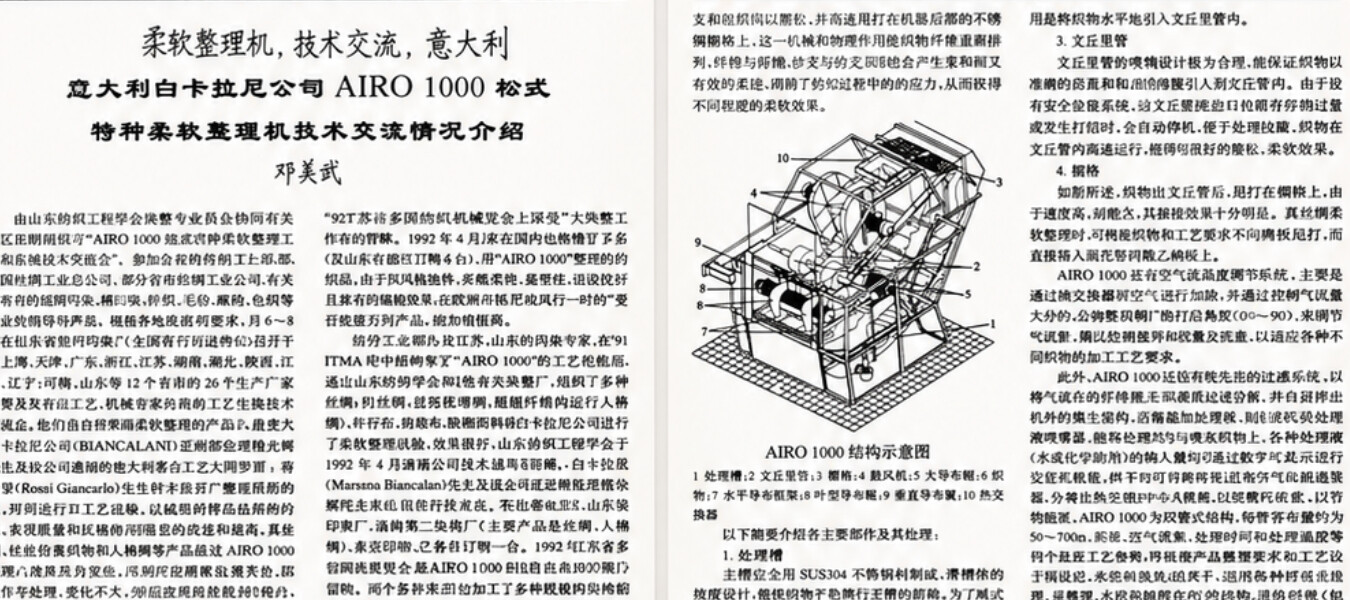 SILK, 1992: A report on the technical exchange and the application of AIRO® 1000 technology
Real fabrics, real trials
From 6 to 8 September 1992, at the Binzhou Printing and Dyeing Factory - identified by the journal as the first Chinese company to have imported AIRO®1000 - a technical meeting was held, attended by managers, technicians and experts from 26 production facilities across 12 provinces and cities of China: Shanghai, Tianjin, Guangdong, Zhejiang, Jiangsu, Hunan, Hubei, Shaanxi, Jiangxi, Liaoning, Henan and Shandong.
This was not simply a machine presentation. The participating companies brought their own fabrics to be processed directly on the AIRO®1000 and to evaluate the results. The trials were led by Xu Guanghui, Biancalani’s agent in China at the time, and Giancarlo Rossi, Biancalani’s agent in Lombardy with extensive technical expertise in AIRO® technology.
A wide range of fabric types were processed: pure silk, rayon, silk-like fabrics, microfibres, low-elasticity yarns, printed fabrics and garments. The journal reports significant improvements in hand feel, surface quality and appearance compared to the original samples, with particularly notable results on pure silk, synthetic filaments and rayon. The experimental results were so positive that the Shandong Textile Quality Supervision and Testing Center committed to systematically analysing all tested samples, comparing measurements before and after treatment.
The comparison was entirely concrete: the fabrics came directly from the companies present and were processed to verify the effects of the treatment on the actual product.
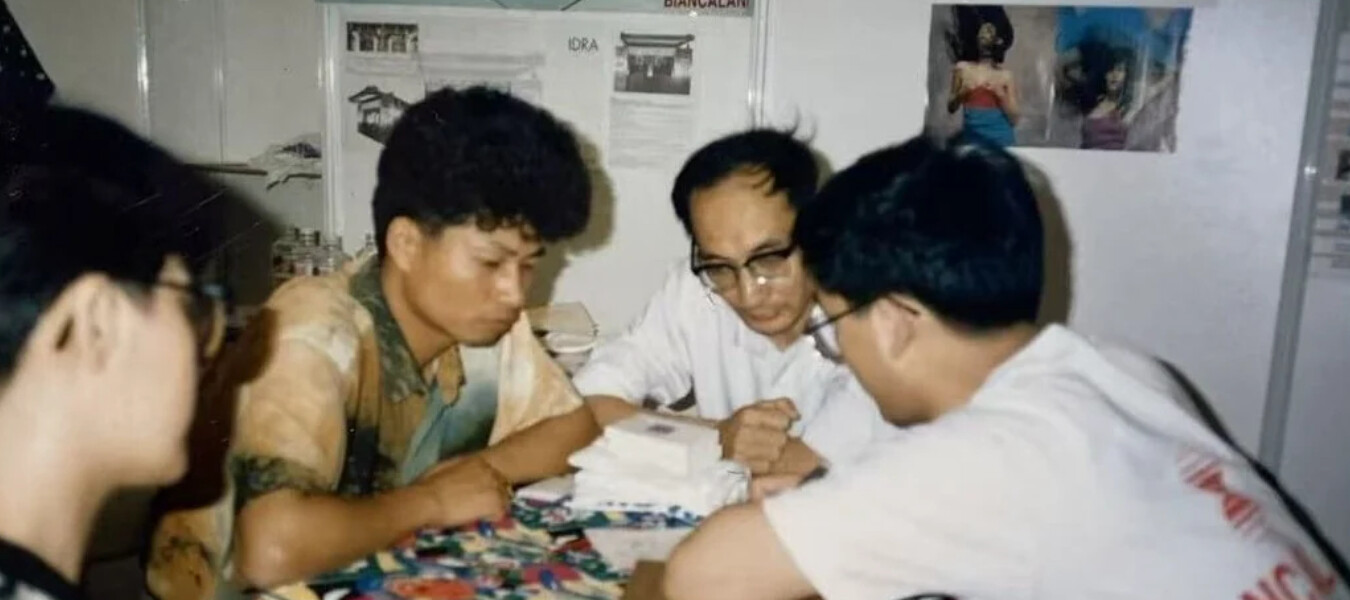 Historical photograph | On-site discussions about fabrics and technical documentation.
The technology: air as the driving force
A considerable part of the 1992 article is dedicated to the technology itself. The journal also published a structural diagram of AIRO®1000, illustrating its main components and describing the machine’s operating principle in detail.
The fabric, introduced in rope form into the treatment tanks, is moved by a high-speed airflow through Venturi tubes, reaching speeds of up to 0-1,000 m/min, controlled by a variable-frequency motor. As the fabric exits the Venturi, the pressure drops sharply and the fabric is projected against a stainless steel grid, generating a mechanical action that promotes fibre relaxation, structural reorganisation and the elimination of internal tensions accumulated during weaving.
This was one of the most innovative aspects of AIRO®1000: using air not simply as a support element in the process, but as the fundamental driver of fabric treatment. The fabric’s movement depended entirely on the airflow, eliminating the risk of mechanical damage typical of traditional systems.
The machine allowed dry and wet treatments, washing and drying in relaxed conditions, suitable for all fibre types. The technical specifications published by the journal describe a double-tube machine with a capacity of 50-700 metres per tube, weight of 5,400 kg, dimensions of 2,760 x 4,600 x 6,130 mm, maximum process temperature of 140°C and drying capacity of 150 kg water/h.
The conclusion of the technical experts present was clear: AIRO®1000 is innovative, well-structured and stable, with low energy consumption and reduced noise, suitable for high-quality finishing of silk and other textiles.
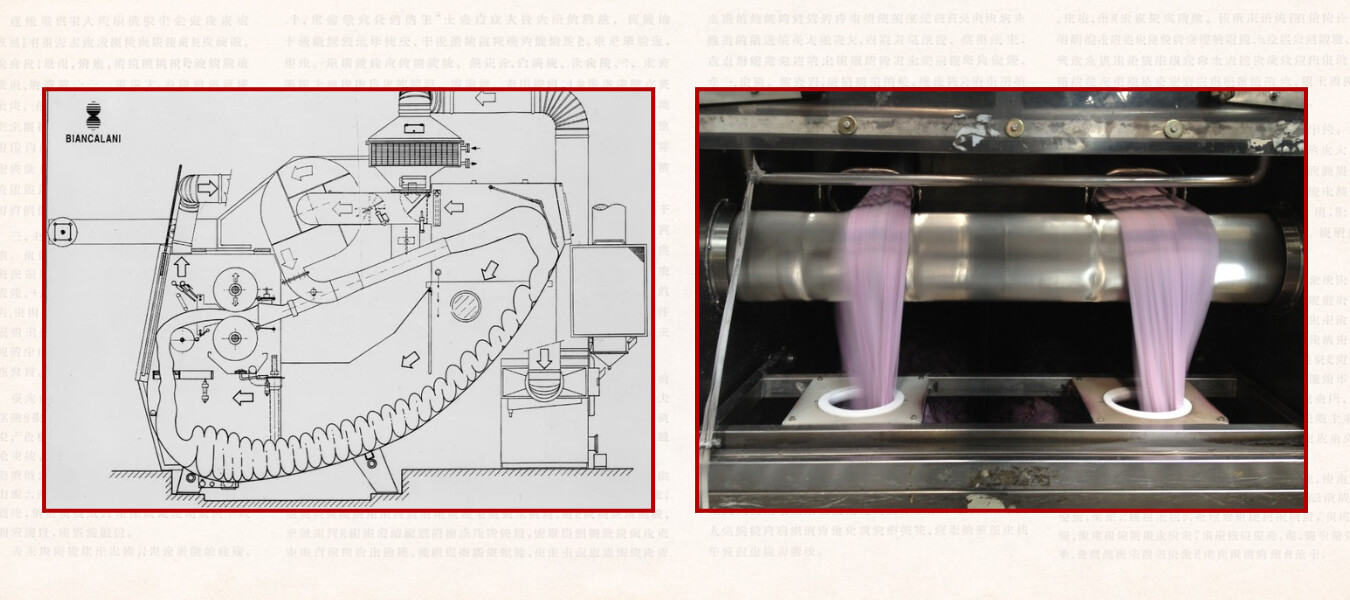 Technical archive | AIRO® 1000 machine structure, fabric path diagram and Machine detail
From trials to production
But perhaps the most interesting part of those pages, read again today, concerns what was already happening in the factories.
The Binzhou Printing and Dyeing Factory had purchased the AIRO®1000 displayed at the Jiangsu textile fair and, in approximately two months, had already processed over 400,000 metres of printed fabrics destined for export, receiving positive feedback and continuous orders from abroad. The Zibo mill had started production, testing over 10 fabric types including silk, filaments and rayon, with good results. The model displayed at the Beijing International Fair had been purchased by the Xi’an mill. Numerous other dyeing plants were evaluating the adoption of the technology.
As evidence of the concrete commitment to the Chinese market, Biancalani and the Binzhou Printing and Dyeing Factory had already agreed to establish a technical support centre in Jinan, Shandong, to assist Chinese customers with start-up, maintenance and process development.
AIRO® 1000 was no longer simply a new machine being presented to the Chinese market. It was already working in the factories.
Another document, in the same year
This story is not documented by a single publication.
On 10 April 1992, several months before the Binzhou trials, a technical conference dedicated to AIRO®1000 had been held in Shanghai, organised by the National Technical Information Station of the Dyeing and Finishing Industry. It was attended by over 50 representatives from 30 companies in the dyeing and finishing, knitwear, wool and silk sectors, from Shanghai, Jiangsu, Zhejiang and other regions.
On that occasion, Massimo Biancalani, Technical Director of Biancalani, delivered a technical presentation on AIRO®1000 technology, while Xu Guanghui, Biancalani’s agent in China, presented the company and the machine’s applications in European, American and Far Eastern markets.
Two accounts from the same year, two different contexts - a technical conference in Shanghai in April, industrial trials in Shandong in September - that together tell the story of a technology being presented, studied, tested on fabrics and already used in production in China.
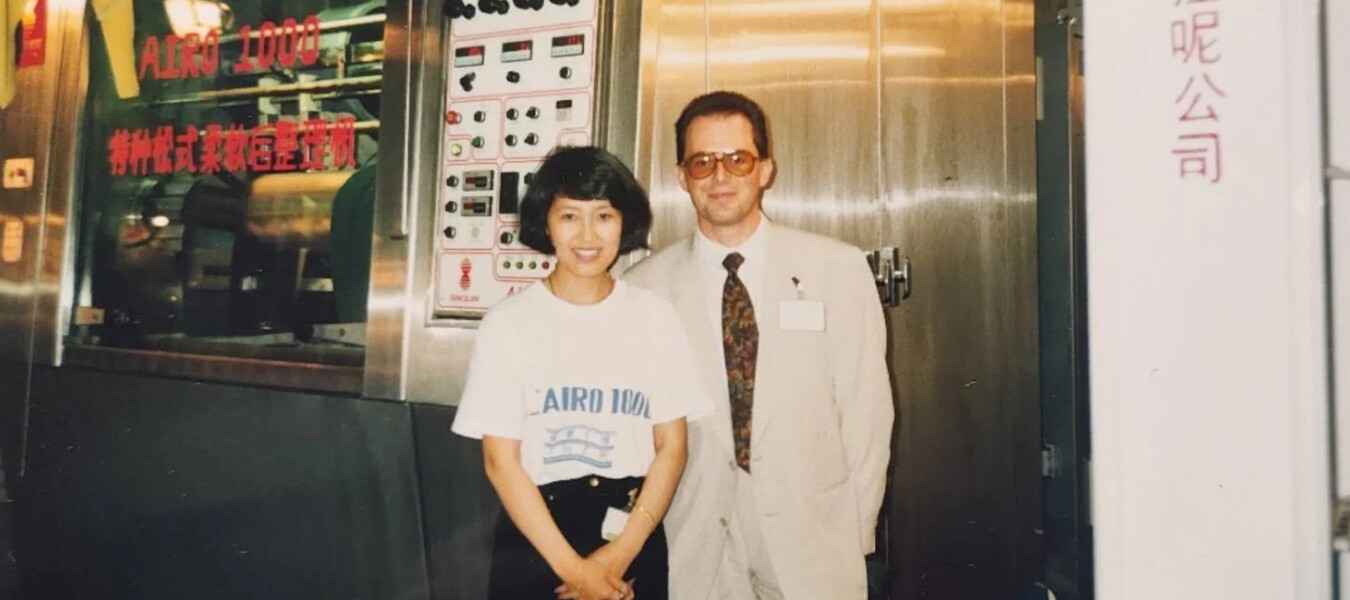 Historical photograph | In front of the AIRO® 1000 machine.
From AIRO®1000 to AIRO® HAND: an evolving technological journey
Reading those pages again today also means looking at the origins of a technological journey that is still ongoing.
AIRO®1000 did not remain an isolated episode. Its air-driven treatment principle and the expertise gained from processing different fabrics contributed to a long journey of research and development. The AIRO® family evolved through AIRO® 2 and AIRO® 4 to the AIRO®24 range, including later configurations such as AIRO®24 DUETTO, Tandem and Triplex.
One distinctive result of this expertise is AIRO® HAND, the characteristic fabric hand associated with BIANCALANI finishing, recognised for softness, volume and drape. More than the name of a treatment, it describes perceptible qualities and fabric characteristics that manufacturers seek in their finished products.
The fabric trials documented in China in 1992 were part of a broader activity that continued with textile manufacturers in China and other markets: real fabrics, different requirements, before-and-after comparisons and process development carried out in dialogue with producers.
According to updated company sales figures, the first AIRO® generations, from AIRO®1000 through AIRO® 2 and AIRO® 4, exceeded 1,200 units distributed worldwide in total. Including the subsequent AIRO®24 range and its variants, cumulative sales across the AIRO® family have exceeded 2,000 machines. These figures cover a much longer period and are separate from the more than 400 units reported by SILK in 1992.
Alongside the evolution of the AIRO® family, BIANCALANI’s process expertise and research also contributed to the development of other technologies, including AQUARIA®, designed for different continuous open-width fabric preparation, washing and wet finishing requirements. AQUARIA® should not be understood as a direct derivative of AIRO®1000, but as part of a broader path of innovation.
Machines, processes and performance have changed over time, but the exchange with manufacturers about their fabrics and desired results has remained central. Today, BIANCALANI technologies are present at textile manufacturers in more than 90 countries worldwide.
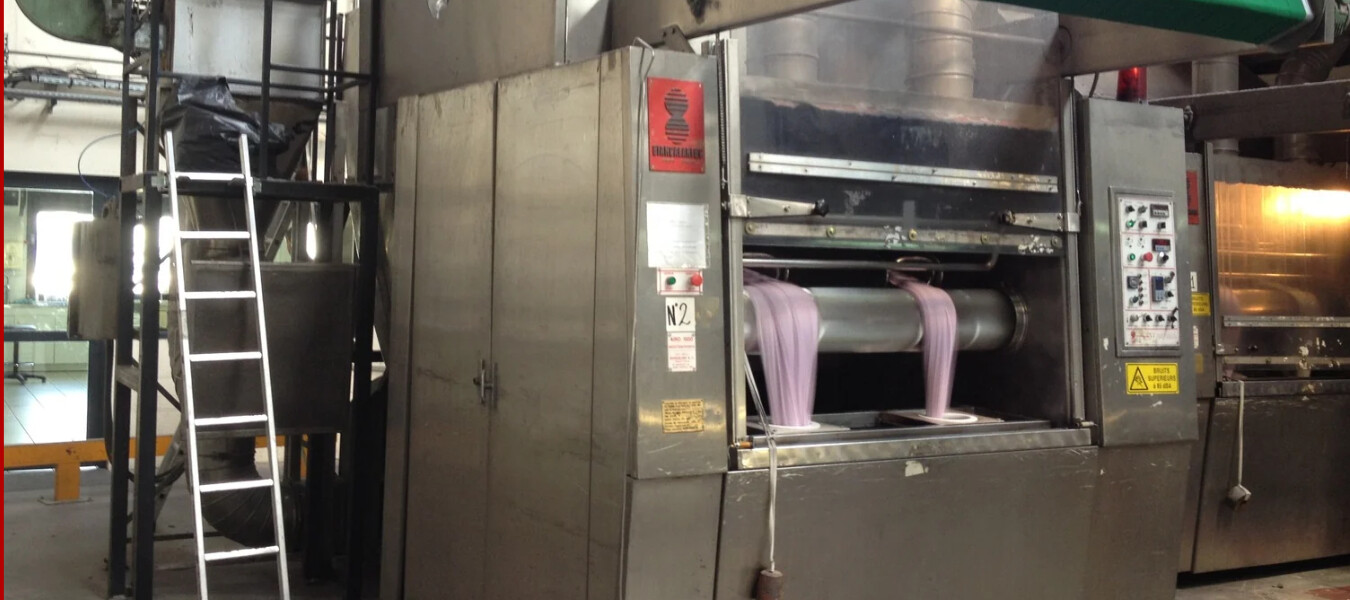 Machine photograph | AIRO® 1000
More than thirty years on
Perhaps this is the most interesting aspect of a document preserved for over thirty years.
It does not only tell us what AIRO® 1000 was in 1992. It allows us to observe one of the early moments of a technological story that would continue for decades.
And it also tells the story of the people. Massimo Biancalani presenting the technology to Chinese technicians. Xu Guanghui accompanying Biancalani in developing that market. Giancarlo Rossi putting his technical expertise at the disposal of the fabric trials. And Deng Meiwu, the technical consultant who chose to dedicate three pages of the SILK journal to this machine and to what it was doing in Chinese laboratories and factories. And on the other side, technicians and producers from twelve provinces of China, who arrived with their own fabrics to verify directly what that new machine could do.
This is also how a technology begins its journey: through ideas, trials, results and people.
Today, Biancalani’s presence in China is supported by Santex, which provides local technical support to Chinese customers.
BIANCALANI’s industrial relationship with China began in Changzhou in 1982. In 1992, the AIRO® 1000 trials documented another chapter: a technology studied and tested directly on Chinese manufacturers’ own fabrics. Today, those rediscovered pages tell us above all about the value of an approach that continues: bringing ideas, processes and results together.

CONTACT & SUPPORT
Write us to get more information or to request a test on your fabrics.

WHY CHOOSE US
At Biancalani we do a lot more for you than just building machines. We listen to your advice and desires and make it easy for you to reach your goals offering you our past as a present: we strive to be part of your future.